Overview
▼ Understanding Sub-Inspector Recruitment - Career in Central Police Organization
The SSC CPO (Central Police Organisation) Exam is a prestigious national-level recruitment conducted by the Staff Selection Commission (SSC) to select qualified candidates for the position of Sub-Inspector (SI) in Delhi Police and various Central Armed Police Forces (CAPFs). This is one of the most sought-after government jobs for graduates in India.
The 2026 recruitment offers 3,073 vacancies for eligible candidates across multiple forces. This is an excellent opportunity for young Indians to serve the nation in a leadership position within the paramilitary and security forces.
SSC CPO Recruitment Overview:
- Recruiting Organization: Staff Selection Commission (SSC)
- Total Vacancies: 3,073 posts
- Position: Sub-Inspector (SI) Executive and General Duty
- Posting Forces: Delhi Police and Central Armed Police Forces (CAPFs)
- Eligibility: Bachelor's Degree (Graduate)
- Age Limit: 20-25 years (with age relaxation for reserved categories)
- Selection Process: Paper 1 → PST/PET → Paper 2 → Medical Examination
- Exam Mode: Computer-Based Test (CBT)
- Salary: ₹35,400 - ₹1,12,400 (Pay Level-6)
Central Armed Police Forces (CAPFs) Recruiting Through This Exam:
| Force Name | Abbreviation | Position | Vacancies (2025) |
|---|
| Central Reserve Police Force | CRPF | Sub-Inspector (GD) | 1,029 |
| Central Industrial Security Force | CISF | Sub-Inspector (GD) | 1,294 |
| Indo-Tibetan Border Police | ITBP | Sub-Inspector (GD) | 233 |
| Border Security Force | BSF | Sub-Inspector (GD) | 223 |
| Sashastra Seema Bal | SSB | Sub-Inspector (GD) | 82 |
| Delhi Police | DP | Sub-Inspector (Executive) | 212 |
Vacancy Highlight: SSC CPO 2026 is recruiting for a total of 3,073 posts across Delhi Police and various CAPFs. The notification is expected on May 31, 2026, with applications closing on June 30, 2026. This is a leadership position with excellent career growth opportunities.
Why Choose This Career Path?
- Leadership position in prestigious paramilitary forces
- Secure government job with excellent salary and benefits
- Job security and pension benefits
- Career growth opportunities and promotions to higher ranks
- Respect and honor in society
- Medical and health benefits for self and family
- Competitive salary with various allowances
- Professional training and leadership development opportunities
- Posting opportunities across India
Note: SSC CPO recruitment is conducted annually by the Staff Selection Commission. The exam is highly competitive with lakhs of candidates appearing every year. A graduate degree is mandatory for this position, which distinguishes it from other SSC recruitment exams. Proper preparation and understanding of the exam pattern and syllabus are essential for success.
▼ 2026 Recruitment Timeline - Key Dates, Notification & Application Process
The 2026 recruitment drive is a major recruitment initiative offering 3,073 posts across Delhi Police and Central Armed Police Forces. The notification is expected to be released on May 31, 2026, with the application process running from May 31 to June 30, 2026.
Important Dates for 2026 Recruitment:
| Event | Expected Date |
|---|
| Notification Release | May 31, 2026 (Expected) |
| Application Start Date | May 31, 2026 (Expected) |
| Application Last Date | June 30, 2026 (Expected) |
| Application Correction Window | July 2026 (Tentative) |
| Slot Booking Date | August 2026 (Tentative) |
| Paper 1 Exam | October – November 2026 (Tentative) |
| Result Declaration (Paper 1) | December 2026 (Tentative) |
| PST/PET | January – February 2027 (Tentative) |
| Paper 2 Exam | March 2027 (Tentative) |
| Medical Examination | April – May 2027 (Tentative) |
Vacancy Distribution (2025 Cycle):
- Total Posts: 3,073
- Sub-Inspector (Executive) in Delhi Police: 212 posts
- Sub-Inspector (GD) in CRPF: 1,029 posts
- Sub-Inspector (GD) in CISF: 1,294 posts
- Sub-Inspector (GD) in ITBP: 233 posts
- Sub-Inspector (GD) in BSF: 223 posts
- Sub-Inspector (GD) in SSB: 82 posts
- Reserved Category Posts: SC/ST/OBC/EWS reservations applicable
- Posts for Ex-Servicemen (ExS): Available
Application Fee Structure:
| Category | Application Fee |
|---|
| General/OBC Candidates | ₹100 |
| SC/ST Candidates | Fee Exempt |
| Female Candidates | Fee Exempt |
| Ex-Servicemen (ExS) | Fee Exempt |
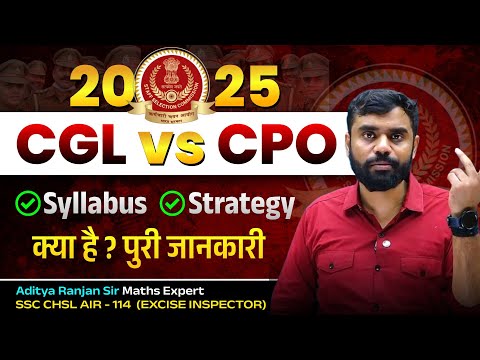
Watch: SSC CPO vs SSC CGL - Key Differences Explained
▶
Quick Comparison: SSC CPO vs SSC CGL:- SSC CPO: Sub-Inspector in Police/CAPFs, Graduate required, Higher salary (₹35,400–₹1,12,400), Leadership position
- SSC CGL: Various Group B & C posts, 12th pass eligible, Lower salary, Administrative roles
- Exam Difficulty: SSC CPO is more challenging due to higher qualification requirement and competitive nature
- Career Prospects: SSC CPO offers better career growth and leadership opportunities
Recruitment Statistics: The 2026 recruitment drive is recruiting 3,073 candidates across 6 major forces (Delhi Police and 5 CAPFs). The exam is expected to be held from October–November 2026, with multiple shifts to accommodate the large number of candidates.
▼ Eligibility Requirements - Education, Age Limit & Nationality
The eligibility criteria are designed to ensure that only qualified and fit candidates are selected for the Sub-Inspector position. The eligibility requirements include nationality, educational qualification, age limit, and physical standards.
Nationality Requirements:
- Candidates must be citizens of India
- Dual citizenship is not permitted
- Candidates of Indian origin (NRI/OCI) may be eligible under specific conditions
Educational Qualification:
| Qualification | Details |
|---|
| Minimum Education | Bachelor's Degree from a recognized university |
| Equivalent Qualification | Any Bachelor's Degree (B.A., B.Sc., B.Com., B.Tech., etc.) |
| Medium of Education | Any recognized medium (English, Hindi, Regional Languages) |
| Marks Requirement | No minimum marks requirement specified |
| Distance Learning | Recognized distance learning degrees are accepted |
Age Limit 2026:
| Category | Age Limit (Years) | Age Relaxation (Years) |
|---|
| General | 20–25 years | No relaxation |
| SC/ST | 20–30 years | 5 years |
| OBC | 20–28 years | 3 years |
| Ex-Servicemen (ExS) | 20–30 years | 3 years (after military service deduction) |
| Persons with Disabilities (PwD) | 20–30 years | 10 years |
Physical Standards:
| Physical Requirement | Male Candidates | Female Candidates |
|---|
| Height | Minimum 165 cm | Minimum 150 cm |
| Chest (Unexpanded) | Minimum 76 cm | Not applicable |
| Chest (Expanded) | Minimum 81 cm | Not applicable |
| Expansion | Minimum 5 cm | Not applicable |
| BMI | 18.5 - 32 kg/m² | 18.5 - 32 kg/m² |
Disqualification Criteria:
- Candidates with criminal background or pending criminal cases
- Candidates with poor conduct or disciplinary action history
- Candidates with medical unfitness or serious health conditions
- Candidates who fail to meet physical standards
- Candidates with false or fraudulent documents
- Candidates who do not meet the age and educational requirements
- Candidates with communication disorders or hearing impairment
Important: Candidates must meet all eligibility criteria at the time of application as well as at the time of document verification. Any discrepancy or false information can lead to disqualification. Age is calculated as on the date of notification release. Physical standards are verified during the PST (Physical Standards Test) stage. Educational qualification must be from a recognized university.
▼ Exam Pattern & Syllabus - Two-Tier Computer-Based Test
The exam pattern consists of a two-tier Computer-Based Test (CBT) followed by Physical Efficiency Test (PET), Physical Standards Test (PST), Medical Examination, and Document Verification.
Paper 1 (Tier 1) Pattern:
| Section | Questions | Marks | Duration |
|---|
| General Intelligence & Reasoning | 50 | 50 | 2 Hours (30 min sectional timer) |
| General Knowledge & Awareness | 50 | 50 |
| Quantitative Aptitude | 50 | 50 |
| English Comprehension | 50 | 50 |
| Total | 200 | 200 | 2 Hours |
Paper 2 (Tier 2) Pattern:
| Section | Questions | Marks | Duration |
|---|
| English Language & Comprehension | 100 | 100 | 2 Hours |
Paper 1 Syllabus Overview:
1. General Intelligence & Reasoning (50 Marks):
- Analogies and Classification
- Coding-Decoding
- Series and Patterns
- Logical Reasoning
- Venn Diagrams
- Syllogism
- Statement and Conclusions
- Direction and Distance
- Blood Relations
- Cube and Dice
2. General Knowledge & Awareness (50 Marks):
- Current Affairs and Recent Events
- History and Geography of India
- Indian Polity and Constitution
- Economy and Finance
- Science and Technology
- Sports and Culture
- Important Days and Dates
- Books and Authors
- Awards and Honors
- International Organizations
3. Quantitative Aptitude (50 Marks):
- Number System and Operations
- Algebra and Equations
- Geometry and Trigonometry
- Percentages and Ratios
- Profit and Loss
- Simple and Compound Interest
- Time and Work
- Speed and Distance
- Data Interpretation
- Mensuration
4. English Comprehension (50 Marks):
- Reading Comprehension
- Grammar and Vocabulary
- Sentence Correction
- Synonyms and Antonyms
- Idioms and Phrases
- Spelling and Punctuation
- Fill in the Blanks
- Error Detection
Exam Features:
- Negative Marking: 0.25 marks per wrong answer in Paper 1
- Question Type: Objective (Multiple Choice)
- Total Questions (Paper 1): 200
- Total Marks (Paper 1): 200
- Duration (Paper 1): 2 hours with 30-minute sectional timer
- Language: English and Hindi (candidates can choose)
- Mode: Computer-Based Test (CBT)
Exam Strategy: With 2 hours for 200 questions in Paper 1, you have approximately 36 seconds per question. The new 30-minute sectional timer means you must manage time within each section. Focus on accuracy over speed. Avoid attempting difficult questions that consume time. Start with sections where you are confident. Manage negative marking carefully.
▼ Selection Process - Multi-Stage Recruitment & Physical Tests
The selection process is a multi-stage procedure designed to select the most suitable candidates for the Sub-Inspector position.
Selection Process Stages:
| Stage | Test Name | Details |
|---|
| Stage 1 | Paper 1 (CBT) | 200 questions, 200 marks, 2 hours, Objective type |
| Stage 2 | Physical Efficiency Test (PET) | Running, Long Jump, High Jump - Physical tasks |
| Stage 3 | Physical Standards Test (PST) | Height, Chest (males), Weight verification |
| Stage 4 | Paper 2 (CBT) | 100 questions, 100 marks, 2 hours, English |
| Stage 5 | Medical Examination | Medical fitness test and health check-up |
| Stage 6 | Document Verification | Verification of educational and other certificates |
Stage 1: Paper 1 (Computer-Based Test):
- Objective-type examination with 200 questions
- Total marks: 200
- Duration: 2 hours with 30-minute sectional timer
- Negative marking: 0.25 marks per wrong answer
- Questions from General Intelligence, GK, Quantitative Aptitude, and English
- Candidates qualify based on merit and cut-off marks
- Cut-off varies by category and force
Stage 2: Physical Efficiency Test (PET):
| Event | Male Candidates | Female Candidates |
|---|
| Running (1600m) | 6 minutes 40 seconds | 8 minutes 40 seconds |
| Long Jump | 4.5 meters | 3.5 meters |
| High Jump | 1.2 meters | 1 meter |
Stage 3: Physical Standards Test (PST):
- Verification of height against prescribed standards
- Verification of chest measurement (males only)
- Verification of weight against height
- Candidates must meet minimum physical standards
- No relaxation in physical standards
Stage 4: Paper 2 (English Language & Comprehension):
- 100 questions, 100 marks, 2 hours
- English language and comprehension test
- Negative marking: 0.25 marks per wrong answer
- Only candidates who qualify Paper 1 and PET/PST are called for Paper 2
Stage 5: Medical Examination:
- Comprehensive medical fitness test
- Vision and hearing test
- Blood pressure and heart rate check
- General health assessment
- Candidates must be medically fit for Sub-Inspector service
Stage 6: Document Verification:
- Verification of educational certificates (Bachelor's Degree)
- Verification of identity and address proof
- Verification of caste certificate (if applicable)
- Verification of other relevant documents
- Final stage before appointment
Important: Candidates must qualify all stages of the selection process to be appointed. Failure in any stage will lead to disqualification. Physical fitness is as important as academic knowledge. Start physical training early to meet the PET standards. Medical fitness is mandatory - any serious health condition may lead to rejection.
▼ Salary Structure, Benefits & Career Advancement
The salary package for Sub-Inspector is highly competitive and offers excellent financial security along with numerous benefits.
Pay Scale 2026:
| Pay Component | Amount (₹) |
|---|
| Pay Level | Pay Level-6 |
| Basic Pay Range | ₹35,400 – ₹1,12,400 |
| Starting Basic Pay | ₹35,400 |
| Approximate In-Hand Salary | ₹45,000 – ₹65,000+ |
Allowances & Benefits:
- Dearness Allowance (DA)
- House Rent Allowance (HRA)
- Transport Allowance
- Uniform Allowance
- Special Allowance
- Other Force-specific Allowances
- Overtime Allowance
Comprehensive Benefits Package:
- Permanent Government Job with job security
- Pension benefits after retirement
- Medical and health insurance for self and family
- Leave benefits (Casual, Earned, Sick Leave)
- Housing facilities in some forces
- Educational benefits for children
- Gratuity on retirement
- Group Insurance Scheme
- Recreation and sports facilities
- Professional training and leadership development
Salary Breakdown Example (for basic pay of ₹35,400):
- Basic Pay: ₹35,400
- Dearness Allowance (DA): ~₹8,000–10,000
- House Rent Allowance (HRA): ~₹5,000–7,000
- Other Allowances: ~₹3,000–5,000
- Approximate In-Hand Salary: ₹51,400–57,400
Career Progression & Promotions:
| Position | Promotion Criteria | Experience Required |
|---|
| Sub-Inspector (SI) | Entry Position | Starting Position |
| Inspector | Merit and seniority | 8–10 years |
| Deputy Superintendent (DSP) | Examination and performance | 12–15 years |
| Superintendent (SP) | Competitive examination | 15–20 years |
| Senior Superintendent (SSP) | Competitive examination | 20+ years |
Retirement Benefits:
- Pension: Defined Benefit Pension Scheme
- Gratuity: One month's basic pay for each completed year of service
- Leave Encashment: Encashment of unused leave
- Family Pension: For dependents after retirement
- Medical Benefits: Post-retirement medical facilities
Career Prospects: This position offers excellent career growth opportunities. With dedication and hard work, you can progress to higher ranks like Inspector, DSP, SP, and SSP. The salary increases significantly with each promotion. The job provides financial stability, social respect, and the opportunity to serve the nation in a leadership capacity.
▼ Preparation Strategy - Study Tips & Resources for Success
Effective preparation is the key to success in this highly competitive exam. With lakhs of candidates appearing for this recruitment, a well-planned study strategy and consistent effort are essential.
Preparation Strategy:
- Understand the Exam Pattern: Thoroughly understand the two-tier CBT exam pattern, syllabus, and marking scheme
- Create a Study Plan: Develop a structured study schedule covering all topics for both papers
- Study Material: Use standard textbooks and online resources for each subject
- Topic-wise Preparation: Focus on one topic at a time and master it completely
- Regular Practice: Solve practice questions and previous year papers daily
- Mock Tests: Take regular mock tests to assess your preparation level
- Time Management: Practice time management during mock tests (36 seconds per question)
- Revision: Regularly revise all topics to retain information
- Physical Training: Start physical training early for PET preparation
- Stay Updated: Keep track of current affairs and recent events
Subject-wise Preparation Tips:
General Intelligence & Reasoning:
- Practice logical reasoning questions regularly
- Solve puzzles and pattern-based questions
- Learn coding-decoding techniques
- Practice series and analogy questions
- Focus on accuracy over speed
General Knowledge & Awareness:
- Read newspapers daily for current affairs
- Follow news channels and online news portals
- Study Indian history, geography, and polity
- Keep track of important national and international events
- Prepare notes on important topics and revise regularly
Quantitative Aptitude:
- Clear your basic concepts first
- Practice calculation-based questions
- Focus on speed and accuracy
- Solve previous year papers to understand question patterns
- Use shortcuts and tricks for faster calculations
English Comprehension:
- Improve vocabulary by reading regularly
- Practice grammar and sentence correction
- Read comprehension passages and practice questions
- Learn synonyms and antonyms
- Practice error detection and fill-in-the-blanks questions
Physical Efficiency Test (PET) Preparation:
- Start physical training 4-6 months before the exam
- Practice running regularly to build stamina
- Include strength training exercises
- Practice long jump and high jump techniques
- Maintain proper diet and sleep schedule
- Avoid injuries by warming up before exercise
Recommended Study Resources:
- Books: Standard preparation books from reputed publishers
- Online Platforms: Official website, YouTube channels, online coaching platforms
- Mock Tests: Take online mock tests regularly
- Previous Year Papers: Solve previous year question papers
- News Portals: Read daily news from major news websites
- Study Groups: Join study groups for peer learning
Do's and Don'ts:
| Do's | Don'ts |
|---|
| Study regularly and consistently | Don't skip topics or subjects |
| Take mock tests regularly | Don't rely on shortcuts only |
| Revise topics regularly | Don't neglect physical fitness |
| Stay updated with current affairs | Don't waste time on irrelevant topics |
| Maintain a balanced diet and sleep | Don't study late into the night |
| Practice time management | Don't attempt all questions randomly |
Preparation Timeline: Start your preparation at least 6-8 months before the exam. Divide your preparation into phases: Foundation (Month 1-2), Main Preparation (Month 3-5), Revision and Mock Tests (Month 6-8). Allocate time for physical training alongside academic preparation. Maintain consistency and discipline throughout your preparation journey. Focus on both Paper 1 and Paper 2 preparation.